Tuesday, May 17, 2011

Corsair Gaming Audio Series SP2500

0 comments
Nowadays 2.1 Channel speaker systems might be an ancient technology but it is an easy technology and save lot money on you wallet too, you won’t have a headache from Install it. Today we have an interesting Corsair Gaming Audio Series SP2500 reviews Corsair has an advanced 2.1 set that demands attention: the Gaming Audio Series SP2500 speaker system.
Corsair Gaming Audio Series SP2500
Gaming Audio Series SP2500

 
            The Corsair SP2500 speaker system consists of a powerful subwoofer and a pair of dual-driver satellites (midrange and tweeter), with advanced features that set the kit apart from more basic 2.1 systems. The SP2500 is outfitted with an 8-inch subwoofer that resides in a fouarthorder bandpass, tuned power enclosure. The sub is capable of handling 120 watts (RMS) of power, and the dynamics of its enclosure and tuned port allow it to offer hard-hitting, booming bass with minimal distortion. The SP2500’s satellites feature 3-inch midrange, 40-watt drivers, and 1-inch ferrofluid-cooled, silk diaphragm 16-watt tweeters. Aside from using quality drivers, Corsair also went the extra mile and equipped each of those drivers with its own dedicated class-D amplifier and DSP. This type of configuration gives Corsair the ability to set very precise crossover points and power output per driver, with the end result being lowdistortion, high-quality, crisp output from every speaker. In addition to the advanced speaker configuration, the Corsair SP2500 2.1- channel system also includes a control pod with color screen. The pod gives users the ability to choose from a variety of preset equalizer configurations and program presets, including Jazz, Pop, Action, FPS, etc. One of the EQ settings, Mod X, processes Blu-ray and DVD audio for optimal performance on a 2.1-channel speaker system, rather than a movietheater environment. I found the SP2500 offered excellent sound quality in a wide variety of listening scenarios, including music, movies, and, of course, gaming. Some subtle sounds in games such as Left 4 Dead 2 were perhaps a little too subtle with only two speakers and a sub, but in terms of overall sound quality, the SP2500 speaker system is fantastic and worth every bit of its asking price.
Specs: Frequency response: 35Hz to 20kHz +/- 3dB; Power: 232 watts total power; Subwoofer: 8-inch, 120W; Satellites: 3-inch midrange drivers (40W)
1-inch tweeters (16W); Two-year warranty


            Thank to Computer Power User Magazine.

Click here to Read more...

Saturday, May 14, 2011

AMD Phenom II X4 980 Black Edition

0 comments


Although the Radeon graphic cards is make a great selling result but AMD’s CPU is not too much update and it still hard to sell but if you put AMD’s CPU + Radeon graphic cards it will make a greater result than  Intel + Radeon (When CPU’s price is close) Today we have the new product of AMD. It is Phenom II X4 980 Black Edition.

Phenom II X4 980
Black Edition

AMD


          With the Phenom II X4 980 Black Edition, AMD’s line of chips receives another slight speed bump. The 980 BE costs $195, pushing the prices for the other quad-cores down accordingly.
The 975 BE and 970 BE (3.6GHz and 3.5GHz, respectively) step down just a bit to make way for the 980 BE, which is clocked just a hair higher than both, at 3.7GHz. Otherwise, the specifications for these three top quad-cores on AMD’s roster are nearly identical, sporting the same HyperTransport 3.0 link speed,
45nm process, total cache, and max TDP.  Just as solid of a performer as its slightly lower-clocked brethren, the 980 BE is a nice deal at $195, but it also makes the other chips in the line even better deals.


Specs: Socket AM3; Clock speed: 3.7GHz; HyperTransport 3.0 link: 4GHz full duplex; 45nm process;
Cache: 2MB total L2, 6MB shared L3; 125W max TDP
Test system specs: Motherboard: Asus Crosshair IV Extreme; RAM: 4GB OCZ DDR3-2000;
Graphics: ATI Radeon HD 6870; Storage: 74GB Western Digital Raptor WD740


AMD Phenom II
Benchmark Results            X4 980 BE
3DMark 11
Overall X                                1417
Graphics Score                    1283
Physics Score                      4478
Combined Score                  1678
Graphics Test 1*                   6.97
Graphics Test 2*                   7.31
Graphics Test 3*                   6.38
Graphics Test 4*                   3.57
Physics Test*                        14.22
Combined Test*                   7.81
PCMark Vantage Pro
Overall                                   10973
Memories                               8210
TV And Movies                     4527
Gaming                                  11111
Music                                     12815
Communications                   9424
Productivity                           13252
HDD                                       13365
POV-Ray 3.7 Beta**            867.93 PPS
Cinebench 11.5
CPU***                                   4.31
Aliens vs. Predator
(2,560 x 1,600)                     19.1
*fps
**pixels per second
***points

Thank to Computer power user magazine
Click here to Read more...

Wednesday, May 4, 2011

Online Shopping Does Record Business

0 comments
Remember when many people were afraid to shop online? No longer. ComScore
reported in late December that for the first 47 days of the November-December
holiday shopping season, $27.46 billion in business was conducted online, a 12%
spike vs. the same period a year previous. From Dec. 11 to 17 alone, spending
reached roughly $5.51 billion, a 14% increase from the year before. Spending for the
week got a huge boost from the so-called Green Monday (Dec. 13), on which $954
million was spent, and Free Shipping Day (Dec. 17), which 1,500-plus merchants
took part in and generated another $942 million in business. Compared to Dec. 17,
2009, spending jumped a remarkable 61%, ComScore reported. Click here to Read more...

Monday, May 2, 2011

Sapphire HD6970 2GB GDDR5 BFBC2 Vietnam Game Edition

0 comments

AMD’s New Flagship GPU Shakes

Things Up


In last month’s review of the Nvidia
GeForce GTX 580, we advised our readers
to hold off. We’re generally not nostalgic
types, but with the launch of AMD’s
Radeon HD 6970, the contentious battle
for graphics supremacy really takes us back.
There’s nothing quite like two high-end
GPUs launching in close proximity. The
fanboys are frothing, prices are falling, and
we can’t help but get a little teary.
AMD’s Cayman XT owes its 2.7 TFLOPs
of raw compute performance to an 880MHz
core clock, and its 5.5Gbps memory bandwidth
to a 1,375MHz memory clock
and 2GB of GDDR5 running on a 256-
bit bus. Architecturally, the Radeon HD
6970 offers significantly enhanced geometry
performance, even compared to the
6800 series GPUs. Cayman features dual
graphics engines, which double the vertex
and geometry assemblers and deliver faster
geometry setup. Each SIMD features 64
ALUs; there are 24 SIMDs, which gives the
GPU a total of 1,536 ALUs.
AMD also revamped its shader hardware
by moving from VLIW5 (Very Long
Instruction Word; originally introduced
in the R600) to a VLIW4 design, which
utilizes four identical shader units compared
to VLIW5’s four identical units plus one
special function unit. Although the move
from VLIW5 to VLIW4 sounds like a
step backward, the special function unit
was extremely underutilized in previous
architectures, and by cramming more SPUs
into the reclaimed die area, AMD is able to
realize a 10% performance improvement
per mm2. AMD has also tweaked the render
back-ends to deliver faster 16-bit integer and
32-bit floating point operations. There are
96 texture units and 32 ROPs. Other new
features include AMD’s eighth-generation
tessellator and support for a new AA setting
called Enhanced Quality Anti-Aliasing.
The 6970 also features AMD’s fifthgeneration
vapor chamber technology, which
keeps the GPU cool and relatively quiet. As
a nod to enthusiasts, AMD added a dual
BIOS toggle switch, which lets you install a
performance-tweaked BIOS without fear of
bricking the card. If the BIOS fails, just flip
the switch, reflash the BIOS, and try again.
The switch won’t keep you from melting
your card, so practice caution when
installing and running these tweaks.
We like to think of TDP as the
upper limit for component power
consumption, but in reality, GPUs
tended to exceed that limit when
running rare workloads, such as
synthetic benchmarks like FurMark.
With AMD’s new PowerTune technology,
when the predetermined power
limit is reached, the GPU dynamically
lowers the core clock. This is important,
considering the 6970 matches the GTX
580 in load temps and noise output.
AMD claims that typical gaming and
idle power for the 6970 is 190W and
20W, respectively, well below its 250-
watt PowerTune maximum.
At $389, Sapphire’s Radeon HD
6970 (stock settings) is only slightly
more expensive than the GeForce GTX
570, but it surpasses Nvidia’s offering in
every benchmark but S.T.A.L.K.E.R.:
Call of Pripyat. Sapphire’s inclusion of
Battlefield: Bad Company 2 Vietnam
just sweetens the deal. Although it
couldn’t topple the GTX 580, for this
price, AMD has a real winner in the
Radeon HD 6970.

Sapphire HD6970
HD6970 2GB GDDR5
BFBC2 Vietnam
Game Edition
$364.99
Sapphire
www.sapphiretech.com
Add To Cart

Customer Review


Specs & Scores
Sapphire                               Nvidia
Radeon                                  GeForce
                                 HD6970                                GTX 580
Price                       $389.99                                                 $499
Idle Temp              41.6 C                                    39.1 C
Load Temp           85.2 C                                    87 C
Max Noise Output
68.5 dBA                                65.2 dBA
3DMark 11 Performance
Overall                   P5275                                    P6002
Graphics Score    4890                                       5716
Physics Score      9148                                       8329
Combined Score            
                                5050                                       5754
Graphics Test 1 (fps)
21.34                                      24.95
Graphics Test 2 (fps)
25.88                                      26.29
Graphics Test 3 (fps)
31.77                                      36.84
Graphics Test 4 (fps)
14.06                                      17.96
Physics Test (fps)
29.04                                      26.44
Combined Test (fps)
23.49                                      26.77
Games 1,920 x 1,200
Left 4 Dead 2 (8XAA, 16XAF)
119.62                                   133.29
S.T.A.L.K.E.R.:
Call of Pripyat (4XAA)
35.2                                        43.22
Aliens vs. Predator (4XAA)
40                                           43.2
Games  2,560 x 1,600
Left 4 Dead 2 (8XAA, 16XAF)
83.82                                      88.02
S.T.A.L.K.E.R.: CoP (4XAA)
22.63                                      27.3
Aliens vs. Predator (4XAA)
25                                           27.2
Driver: Catalyst 10.11/ForceWare 263.09
Specs: GPU: Cayman XT; Core clock: 880MHz;
Memory: 2GB GDDR5 (1,375MHz); 1,536 Stream
Processors; 96 texture units; 32 ROPs
Test system specs: CPU: 3.33GHz Intel Core i7-980X
EE; Motherboard: Gigabyte GA-X58-USB3; RAM: 6GB
Patriot Sector 7 DDR3; Storage: 128GB Patriot Zephyr
SSD; PSU: Antec TruePower Quattro 1,200W

Article From Computer Power User Magazine
Click here to Read more...

Saturday, April 30, 2011

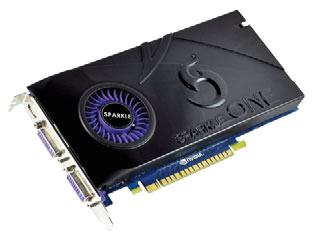
Sparkle GeForce GTS 450 (SXS4501024D5SNS)

0 comments
GeForce
GTS 450
$137.99
Sparkle 
Add to Cart
Specs: GPU: GeForce GTS 450; Core clock: 789MHz; Memory: 1GB GDDR5 (940MHz); Memory
interface: 128-bit; 192 CUDA cores


Just one and two steps down, respectively,
from the GeForce GTX 460 and 470,
the GTS 450’s performance difference in
benchmark results between these models
and can be significant. For example, prior
CPU tests on the GTX 460 were showing
3DMark results around P15000, and our
Sparkle GTX 470 reached P18959. In
contrast, this GTS 450 scores P11162.
That said, the GTS 450 still has
plenty to offer. The core, shader, and
memory clocks are all higher on the
GTS 450 than, say, the GTX 470. From
productivity apps by day to HTPC
movie use by night, Sparkle’s card delivered
solid, stable performance across
all three output ports.
Plus, let’s point out the solid job that
Sparkle has done with Nvidia’s chip. The
GTS 450 may be the fastest single-slot
card we’ve ever benched, and it doesn’t
fall prey to the loud fan issues that can
accompany Nvidia cards under stress.
Sparkle’s GTS 450 sports two DVI and
one mini-HDMI port, plus it includes an
HDMI cable and VGA-to-DVI adapter.
Tack on the 1GB of GDDR5, and this
emerges as a compact way to get a lot of
graphics muscle at a reasonable price.

Benchmark Results
                                Sparkle GTS 450                     Sparkle GTX 470
Core clock               789MHz                                   607MHz
Memory clock (effective)
 3760MHz                                3348MHz
Price                        $137.99                                   $249.99
3DMark Vantage
Overall                     P11162                                    P18959
GPU                         8812                                        15303
Unigine Heaven 2.1 (no AA, 4XAF,1920x1080)
FPS                          21.6                                         41
Scores                    543                                          1034
Minimum                   4.1                                           19.9
Maximum                 48.6                                         84.8
Aliens vs. Predator  1,920 x 1,200
25                                            47.3
Test system specs: CPU: Intel Core i7-980X; Motherboard: Gigabyte GA-X58A-UD7; RAM: 12GB
OCZ PC3-10666 Gold; Storage: Intel 80GB X-25M SSD; PSU: PC Power & Cooling Turbo-Cool 850W;
Windows 7 Ultimate 64-bit

 Article by Computer Power User Magazine
Click here to Read more...

Thursday, April 28, 2011

Tt eSports MEKA G1

0 comments
Mechanical keyswitch keyboards have
been making a bit of a comeback. A
few years ago, it was hard to find anything
but IBM Model M copies or rebranded
Cherry imports in the United States. Now,
there is an ever-growing array of mechanical
keyswitch keyboards available.
Unlike most other mechanical keyswitch
keyboards, the Tt eSports MEKA G1 by
Thermaltake is targeted squarely at gamers.
The MEKA G1 sports a standard layout
with seven multimedia function keys, a
removable wrist rest, and an ultra-heavyduty,
braided cable.
The board’s Cherry MX Black keyswitches
are rated for 50 million keystrokes.
Although some mistakenly classify all
mechanical keyswitch keyboards as “clicky,”
the Cherry MX Black keyswitches are
not. Cherry MX Black switches are linear,
which means there is no tactile bump when
depressed; there’s no audible “click.”

Specs: Interface: USB or PS/2 (via adapter); Switch type: Cherry MX Black; Dimensions: 40 x 430 x
160mm (HxWxD); Cable length: 1.5m; Compatibility: Windows XP/Vista/7
MEKA G1
$139.99
Tt eSports
usa.ttesports.com


Other features include headphone and
microphone jack pass-throughs, an integrated
two-port USB hub, and N-Key rollover.
Note, however, that true N-Key rollover is
only available using the PS/2 connection.
USB keyboards using the standard Windows
driver are limited to 6-key rollover.
Typing on the MEKA G1 is very
pleasing, and the board feels very solid.
Its status LEDs are a bit bright for my
tastes. The lack of a left Windows key
takes some getting used to, but many
gamers despise the left Windows key, so
we can see why Thermaltake decided to
replace it with a Function key. Gamers
who actually use their systems for work
as well should seriously consider checking
out the MEKA G1.

Article by Computer Power User Magazine
Click here to Read more...

Tuesday, April 26, 2011

Cayman Collision AMD’s Top-Tier Radeons Do Battle (2)

0 comments
Asus EAH6970 Overclock Edition
 Asus has done a couple of interesting
things with the EAH6970 Overclock
Edition. The EAH6970 OE is
based on the AMD reference design,
but Asus has tweaked the GPU clock
by 10MHz and integrated a thin, aluminum
cover over the fan shroud, in
lieu of a basic decal. Asus claims the
aluminum cover helps dissipate heat
more evenly, but since it’s affixed to
a thick plastic shroud, the effects on
temperatures are minimal.
In an atypical move for Asus, the
company’s EAH6970 Overclock Edition
ships with a standard accessory
bundle. Accompanying the card,
users will find only a driver/utility
disc, a basic installation guide, Cross-
Fire bridge connector, and a single
power adapter that converts a pair of
6-pin PCI-E connectors into a single
8-pin connector. We should point
out, however, that the utility CD does
include a copy of Asus’ proprietary
Smart Doctor tool, which gives users
the ability to tweak voltages and
further overclock their card.
At $379.99, the Asus EAH6970
OE is only $10 more than the stock
VisionTek and XFX cards, yet it offers
a factory overclock, manufacturersanctioned
voltage tweaks, and a
slightly modded cooler. We wish the
bundle had a few more accoutrements,
but we can’t really complain in light of
the competition.

EAH6970 Overclock Edition
$379.99
ASUS
Add to Cart


Sapphire HD6950
Short of its Sapphire branding
and custom fan shroud decal, there’s
nothing to separate Sapphire’s Radeon
HD 6950 from a straight-up reference
card: It adheres to AMD’s reference
specifications in every way. Sapphire,
however, goes the extra mile with
the accessory bundle in an attempt
to differentiate its card from competing
offerings.
Sapphire bundles a nice assortment
of goodies with its Radeon HD
6950. In the box are a user’s manual
and driver and utility disc, a case
badge, and a coupon for the
Sapphire Select Club,
which grants members
access to five
free promotional
downloads per year,
automatic RMA
registration, and
entries into Sapphire’s
contests and giveaways.
Along with the aforementioned
items, an HDMI cable, mini-DP-to-DP
dongle, DVI-to-VGA adapter, dual PCI-E
power adapters (6-pin), and CrossFire
bridge connector are included, too.
There’s also a copy of Sapphire’s TriXX
tweaking utility bundled with the card,
for some easy overclocking.
For just under $300, the Sapphire
HD6950 is a solid graphics card.

Sapphire Technology HD6950
$283.99
Customer Review
Add to Card


Our Tour Of The Northern Islands
Looking over the results of our battery
of benchmarks, there are some
interesting aspects of performance
to consider. The most obvious is the
relatively large performance delta
separating the Radeon HD 6970 from
the 6950. Although both cards offer
strong performance, the additional
stream processors, texture units, and
higher clocks of the Radeon HD 6970
give it significant edge over the more
affordable 6950.
What’s also immediately evident
are the gains offered by the small
overclocks of the Asus, HIS, and MSI
cards. The HIS Radeon HD 6970
Fan Turbo was technically the fastest
card of the group due to its GPU and
memory frequency advantages over
the other 6970 cards, but its margins
of victory were correspondingly small.
The same can be said for the MSI
R6950 Twin Frozr II/OC. The MSI
card’s 10MHz edge in GPU frequency
over the Sapphire Radeon HD 6950
technically helped the MSI card to
outperform the Sapphire card across
the board, but the deltas separating the
two cards are tiny.
If you’re the type of user who doesn’t
like to manually overclock his graphics
card, we understand the appeal of a
factory-overclocked model, but the
takeaway from these results is that the
current crop of factory overclocked
cards simply doesn’t offer the kind of
performance improvements to warrant
the additional investment. Saving your
money and manually overclocking a
Radeon HD 6900 series card might
be the way to go. But then again, if
history teaches us anything, it’s that
these vendors will eventually introduce
Cayman-based cards with exceptional
overclocks, and those should be worth
waiting for.

 
Specs & Scores  

XFX Radeon           HIS Radeon HD      VisionTek Radeon             Asus EAH6970      Sapphire
HD 6970                 6970 Fan Turbo     HD6970                                   HD 6970                   HD6950
                                                                                                                Overclock Edition
Price        $389.99                   $399.99                   $369.99                                   $379.99                   $299.99
Core Clock
880MHz                   900MHz                   880MHz                                   890MHz                   800MHz
Memory Clock
1,375MHz                1,400MHz                1,375MHz                                1,375MHz                1,250MHz
Memory Interface
256-bit                     256-bit                     256-bit                                     256-bit                     256-bit
Memory  
2GB GDDR5            2GB GDDR5            2GB GDDR5                            2GB GDDR5            2GB GDDR5
3DMark11 (1,920x1,080, Extreme Preset)
OverallScore
1810                        1814                        1809                                        1811                        1610
GPUScore
1625                        1628                        1626                                        1627                        1441
Unigine Heaven v2.1
FPS          27.1                         27.3                         27.1                                         27.2                         23.8
Score      683                          684                          682                                          683                          600
Games 1,920 x 1,200
Left 4 Dead 2 (4XAA, 16XAF)
140.92                     143.21                     140.16                                     142.49                     120.16
Just Cause 2 (4XAA, 16XAF)
72.29                       72.97                       72.1                                         72.43                       65.12
Aliens vs. Predator (4XAA)
40.1                         40.3                        40.1                                         40.2                         35.5
Games 2,560 x 1,600
Left 4 Dead 2 (4XAA, 16XAF)
100.36                     103.1                       99.97                                       102.64                     83.41
Just Cause 2 (4XAA, 16XAF)
51.52                       52.74                       51.49                                       52.27                       44.68
Aliens vs. Predator (4XAA)
25.1                         25.2                        25.1                                         25.1                         22.3
Total System Power Consumption (watts)
Idle           156                          157                          156                                          158                          154
Load        337                          354                          338                                          341                          299
Tessellation and DoF enabled for Aliens vs. Predator tests. Bokeh Filter and GPU Water Simulation not available on AMD-based cards in Just Cause 2.

 Article By Computer Power User Magazine

Click here to Read more...