Showing posts with label radeon. Show all posts

Thursday, May 26, 2011

Sapphire Radeon HD 6950 FleX - Review (3)

1 comments
Accessories


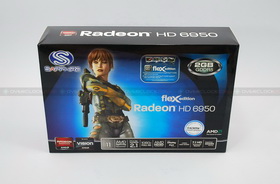
            The package and the bundle of Sapphire Radeon HD 6950 FleX. It fit in the carton box. Oh there is short hair beautiful warrior on the box too. The bundle is complete for use not too much or too low. There are; manual, driver, sticker, 2 power supply cable (6 pins), DVI to D-sub cable converter, HDMI 1.4a cable, Mini-DisplayPort 1.2 to HDMI converter cable, HDMI to DVI converter cable which so important to make the Eyefinity on this HD 6950.

Test Setup


            Sapphire Radeon HD 6950 FleX is running
System
Mainboard                 P6T WS-PRO
CPU                           Intel Core i7 920
Memory                      G.Skill TRIDENT 6GB
VGA                           Sapphire Radeon HD 6950 FleX
Harddisk                    Western WD VelociRaptor 600GB SATA3
Power Supply            Tagan BZ 1300Watt
OS                              Microsoft Windows Seven x64

CPU-Z 1.57
CPU

Memory

Mother Board

GPU
GPU-Z 0.5.2

Catalyst Control Center


Benchmark Result
3DMARK2003


3DMARK2005

3DMARK2006


3DMARK2011


3DMARK VANTAGE
Thank a lot to Overclockzone.com

Buy Now! Click here to Read more...

Friday, May 20, 2011

Sapphire Radeon HD 6950 FleX - Review (1)

0 comments
" Radeon HD 6950 With FleX Heatsink!!! "

The super power card of the 2 titan is already released in the first quarter of this year. The twin head GTX 590 VS the HD 6990 Radeon which the result is already spilt to everywhere. The card that many of the overclocker is discussing about, it is the HD 6950 Radeon, because it can be transformed in to the Radeon HD 6970 very easy. Yes it is. Today I got to test the blue tone graphic card which the FleX heatsink is equipped. It is the Sapphire Radeon HD 6950 FleX.

Now let take a look a specification table.

Hardware Specifications


nVidia GTX570
nVidia GTX580
Radeon HD 6950
Radeon HD 6970
Sapphire HD 6950 FleX


Codename
GF110
GF110
Cayman Pro
Cayman XT
Cayman Pro

Transistor Count (Millions)
3000
3000
2640
2640
2640

Fabrication Process
40 nm
40 nm
40 nm
40 nm
40 nm

Die size (mmˆ2)
520 mmˆ2
520 mmˆ2
389 mmˆ2
389 mmˆ2
389 mmˆ2

Memory (Max)
1.280GB
1.536GB
2GB
2GB
2GB

Uni Shader
480
512
1408
1536
1408

Core Speed
732 MHz
772 MHz
800 MHz
880 MHz
800 MHz

Shader Speed
1464 MHz
1544 MHz
n/a
n/a
n/a

Memory Speed
3800 MHz
4000 MHz
5000 MHz
5500 MHz
5000 MHz

Maximum Fill Rate (MTexels/s)
43900
49400
70400
84500
70400

Memory Bus Width
320-bit
384-bit
256-bit
256-bit
256-bit

Memory Type
GDDR5
GDDR5
GDDR5
GDDR5
GDDR5

Max Memory Bandwidth
152 GB/s
192.4 GB/s
160 GB/s
176 GB/s
160 GB/s

Multi-GPU Support
Yes,
2/3/4Way SLI
Yes,
2/3/4Way SLI
Yes,
CrossfireX
Yes,
CrossfireX
Yes,
CrossfireX

DirectX Version Support
11
11
11
11
11

OpenGL Version Support
4.1
4.1
4.1
4.1
4.1

Bus Type
PCI-E 2.0
PCI-E 2.0
PCI-E 2.1
PCI-E 2.1
PCI-E 2.1


             Radeon HD 6950 is the eleventh card in the Radeon 6000 series (Not count the onboard card). It is the very high performance card which classify by AMD (Only HD 6970 and HD 6990 is more powerful). HD 6950 Radeon’s uni shader is only 128 less then the HD 6970. The experts about the computer graphic say “128 uni shader is walled by the bios of Radeon HD 6950 if we change the bios to the Radeon HD 6970 version, the HD 6950 will turn to HD 6970”. And it is true.


            Radeon HD 6950 is cooked by Sapphire. FleX is the heatsink that look like pencil box cause it noise and hot, but the FleX is only warm. Sapphire Radeon HD 6950 FleX has 1408 uni shader which can be transformed to the HD 6970.


Detail


            The electronic components are re new by Sapphire. PCB board is turned to blue (the master one is brown). The back of the master’s PCI board is look simply clear, but the Sapphire one is impacts by the lot of electronic components. 11 blade of Flex 9 centimeters long, 4000-4200 rpm max speed.


            I really love its layout; I know that Sapphire is intending to design for sucking to money out of your pocket that like to put the handsome graphic card it to case. The detail on the FleX is more than the pervious graphic cards on the 6000 series ostensibly.


Thank to overclockzone.com

Buy Now! Click here to Read more...

Sunday, April 24, 2011

Cayman Collision AMD’s Top-Tier Radeons Do Battle (1)

0 comments
AMD ushered in the DirectX 11
era with the GPU code-named
“Cypress,” which powered the Radeon
HD 5800 series of graphics cards.
Upon its arrival, the Radeon HD 5800
series offered more features and better
performance than any other family of
graphics cards to come before it. In
addition to the aforementioned DX11
support, the 5800 series was outfitted
with many forward-looking technologies,
such as ATI Eyefinity and an updated
UVD engine, and massive amounts of
memory bandwidth (thanks to its 256-
bit interface and support of ultra-fast
GDDR5 memory).
With the introduction of Cypress
and the Radeon HD 5800 series, AMD
wrestled the single-GPU performance
crown from Nvidia and didn’t relinquish
that title for close to six months. Even so,
AMD already had the Radeon HD 5970,
which has a pair of Cypress GPUs at its
heart, in its lineup, and that remains the
fastest single graphics card available today.
There’s no denying Cypress was
a well-designed GPU that struck

an exceptional balance
between performance,
features, and
power. It’s what allowed
AMD to cram two of them
on a single card and consume
less power than a single Nvidia
GF100, while at the same time
offering better overall performance.
But the relative strength of Cypress
also allowed AMD to remain highly
competitive and hold on to a leadership
position in the graphics space
for over a year without refreshing
the high end of its product stack. It’s
hard to believe that the Cypress GPU
and Radeon HD 5800 series hit the
scene way back in September 2009 and
that here in the early part of 2011, a
Cypress-based card remains on top of
the 3D graphics food chain.
Technology inevitably marches on,
though, and despite the strength of
Cypress, AMD has unleashed a new
high-end GPU, code-named “Cayman.”
The Cayman GPU powers the recently
released Radeon HD 6900 series of
graphics cards, which currently
consists of the Radeon
HD 6970 and 6950,
although a dual-
Cayman GPU-powered
card, the Radeon HD
6990 (code-named “Antilles”)
is coming down the
pipeline, as well. Although the
Cayman GPU borrows heavily
from Cypress, it is based on
a totally new architecture that’s
more efficient than AMD’s previous
designs and offers significantly
more performance.


What Sets Cayman Apart?
Cayman is different than Cypress
in a number of ways. First of all, the
Cayman GPU is outfitted with dual
graphics engines, whereas the 5800
series had one. Cayman also features
a new VLIW4 (Very Long Instruction
Word) design; the Cypress GPU used
a VLIW5 design. From head to toe,
so to speak, a Cayman GPU has 24
SIMD engines with a total of 1,536
stream processors, 96 texture units,
32 ROPs (which have been upgraded
from Cypress), and several tweaks to
improve GPU compute performance.
And, as we mentioned last month (see
page 36), the 6900 features AMD’s
eighth-generation tessellator.


Similarities Abound
With the Radeon HD 6900 series now
widely available, we decided to round
up a number of cards based on AMD’s
latest GPU to see how the current crop
of offerings stacks up. We have a half
dozen cards on tap for you here, but,
not surprisingly, most of them are quite
similar. The majority of AMD’s add-in
board partners have introduced Radeon
HD 6900 series cards based on AMD’s
reference design, and as such, there
is relatively little to differentiate the

actual cards. All of the cards featured here
sport 2GB frame buffers and the same
output configuration. All of the Radeon
HD 6970s have the same cooler. There
are a couple of ways each competitor
differentiates itself, but as you’ll see,
the hardware, and hence performance, is
ultimately very similar.


How We Tested
To evaluate the performance of the
Radeon HD 6900 series cards appearing
in this roundup, we used an assortment
of popular games and applications that
cover a wide swathe of the DirectX spectrum,
including DX9, 10.1, and 11. We
installed the cards in a system powered
by a 3.33GHz Intel Core i7-980X,
a Gigabyte X58 Express motherboard,
12GB of DDR3 RAM, and Windows
7 Home Premium 64-bit. We used the
latest available Catalyst drivers as of this
writing, v11.1a.


XFX Radeon HD 6970
XFX does a couple of things to help
its Radeon HD 6970 stand out from
the rest of the pack. Although the card
we took a look at was not overclocked
and is based on the reference design
PCB, XFX has outfitted its 6970
with a custom case bracket featuring
the XFX logo in its exhaust vents
and a custom decal on its fan shroud.
Other than that, this is a reference card
through and through.
XFX also bundles very little with its
Radeon HD 6970. Alongside the card,
all that we found inside the box was a
driver disc, a couple of basic manuals,
a warranty card, a catalog, a “Do Not
Disturb – I’m Gaming” door knob hanger,
and a CrossFire bridge connector.
Although the $369.99 asking price is
tied for the lowest of the group, we still
had hoped XFX would have done a little
more to help its card stand out.

Radeon HD 6970
$369.99
XFX
www.xfxforce.com


HIS Radeon HD 6970 Fan Turbo
Although it is physically indistinguishable
from other reference cards, save
for the custom decal on its fan shroud,
the HIS Radeon HD 6970 Fan Turbo
currently stands alone, as it is the highest
clocked 6970 in our roundup and
potentially the highest clocked
6970 on the market. That said,
its GPU and memory clocks
get only minor 20MHz and
25MHz bumps, respectively.
Regardless, higher clocks translate
to better performance, and
the HIS Radeon HD 6970 Fan Turbo
put up the best benchmark scores of
the group.
Included with the HIS Radeon HD
6970 Fan Turbo is a generic array of
accessories. Along with the card itself,
HIS throws in an obligatory driver CD
and basic user’s manual, along with a
case badge and a few cables and adapters.
There is a pair of peripheral-to-PCI-E
power adapters (one 6-pin, one 8-pin)
in the box, as well, in addition
to a DVI-to-VGA adapter
and CrossFire bridge
connector. Unfortunately,
there are no games
or other applications to
speak of.
Considering the fact that
this card is the most expensive
in our roundup, it would have
been nice to see some differentiating
features other than a minor overclock,
but in the end, the HIS Radeon HD
6970 Fan Turbo is still the fastest
6970 around.
Radeon HD 6970 Fan Turbo
$274.99
Customer Review
Add To Cart


VisionTek Radeon HD 6970
If it didn’t arrive in a VisionTekbranded
box, it would be nearly impossible
to tell where the company’s
Radeon HD 6970 came from. VisionTek’s
Radeon HD 6970 is devoid of any differentiating
features; the card adheres
strictly to AMD’s reference design and
doesn’t even sport any custom stickers
or decals. But that’s not necessarily
a bad thing. In fact, because all of the
Radeon HD 6970 cards featured here are
so similar, taking such a Spartan approach
allowed VisionTek to price its
card competitively.
Other than the actual graphics
card, there’s not much else bundled
with the VisionTek Radeon HD
6970. Alongside the card were only
a basic manual, a driver disc, a single
peripheral-to-PCI-E 6-pin power
adapter (with a high-end card like a
6970, an 8-pin PCI-E power adapter
would be more useful), DVI-to-VGA
adapter, and a CrossFire bridge connector.
What’s more, the driver disc
looked like it was a CD-R with its
label printed on an inkjet. There’s
definitely some cost cutting here,
but that’s probably why VisionTek’s
Radeon HD 6970 is tied for being the
least expensive of the bunch.

Radeon HD 6970
$340.00
VisionTek
Add To Cart


Article By Computer Power User Magazine
Click here to Read more...